
Constipation in Men: Could Your Pelvic Floor Be Part of the Problem?
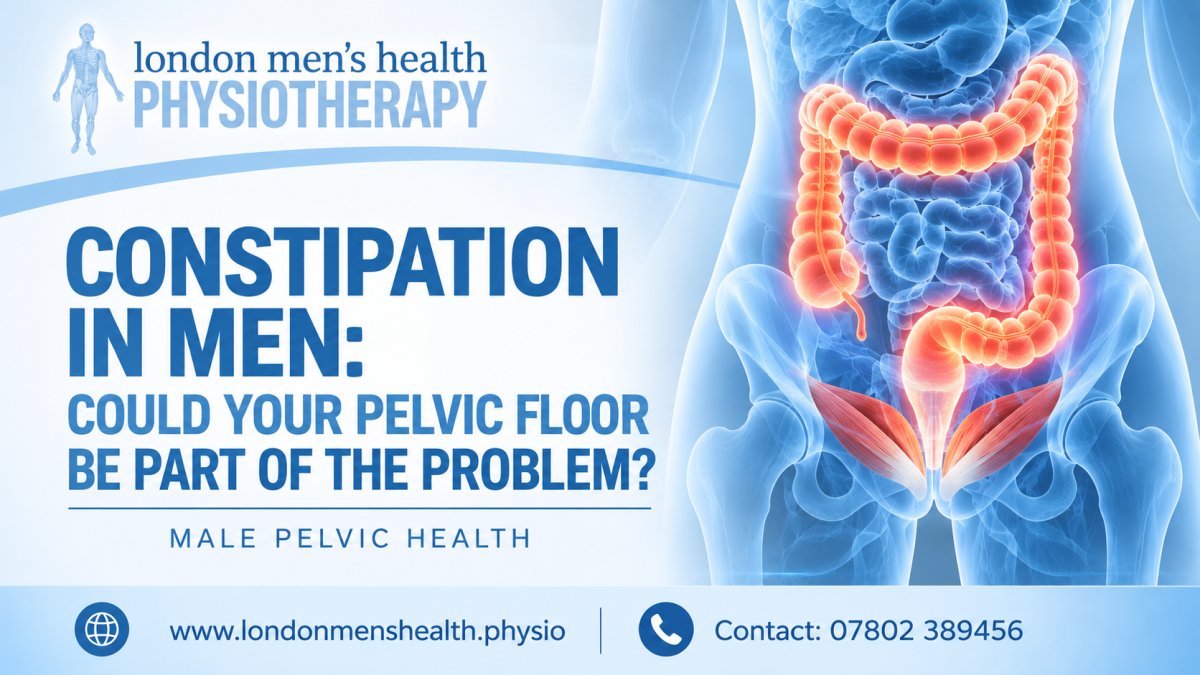
Straining, incomplete emptying and the surprising connection between your bowel and pelvic floor
Constipation isn't something most men particularly want to talk about.
But it is something we talk about in our clinic.
A lot.
And one of the most important things we explain to men is that constipation isn't always simply about what you eat or how much water you drink.
Sometimes the problem is further down.
Your pelvic floor has to relax properly for you to empty your bowels.
If it doesn't, going to the toilet can become surprisingly difficult.
You may find yourself pushing harder and harder, sitting on the toilet for a long time or feeling that you haven't completely emptied.
And if you've already tried increasing your fibre, drinking more water or taking laxatives and you're still struggling, it's reasonable to ask:
Could my pelvic floor be part of the problem?
For some men, the answer is yes.
Can a Tight Pelvic Floor Cause Constipation?
Yes, it can contribute.
Most people associate the pelvic floor with bladder control and sexual function.
But the pelvic floor is also involved in bowel function.
When you open your bowels, the muscles around the back passage and pelvic floor need to coordinate and relax to allow stool to pass.
Think about it like opening a door.
You can push against the door as hard as you like, but if someone is holding the handle on the other side, getting through it is going to be difficult.
Something similar can happen when you are trying to empty your bowels while your pelvic floor isn't relaxing properly.
Instead of relaxing, the muscles may remain tense or sometimes even tighten when you're trying to empty.
The result?
More pushing. More straining. Less emptying.
How Do I Know If My Pelvic Floor Might Be Involved?
There isn't one symptom that proves you have a pelvic floor problem.
But there are patterns that make us think more carefully about pelvic floor function.
You might notice:
• You have to strain significantly to open your bowels
• You spend a long time sitting on the toilet
• You feel that something is stopping the stool coming out
• You frequently feel incompletely emptied afterwards
• You need several attempts to empty
• You find it difficult to relax when sitting on the toilet
• Your symptoms are worse when you're stressed or tense
• You also experience pelvic, rectal or perineal discomfort
• You have urinary urgency or frequency as well as bowel symptoms
• You experience pain after bowel movements
• You have pelvic pain that changes after opening your bowels
Some men describe the sensation very simply:
“It feels like I need to go, but I can't let go.”
That is something worth assessing.
Why Doesn't Pushing Harder Solve It?
Because pushing harder against muscles that aren't relaxing properly can potentially make the whole process less efficient.
Many men develop a habit of holding their breath, bracing their abdomen and pushing extremely hard.
They think:
“If I push harder, eventually something has to happen.”
But bowel emptying should not require an enormous effort every time.
Repeated straining can also encourage you to brace your pelvic floor rather than relax it.
That's why one of the first things we often work on isn't strengthening.
It's coordination.
Can you generate appropriate abdominal pressure while allowing the pelvic floor and anal region to relax?
Those two things need to work together.
Should I Be Doing Kegels?
Not automatically.
This is an important one.
If you're struggling to empty your bowels because your pelvic floor is already overactive or isn't relaxing properly, repeatedly squeezing the pelvic floor may not address the problem.
In some men it may be exactly the opposite of what we're trying to achieve.
This is why we're cautious about generic advice telling every man with a pelvic problem to simply “do Kegels”.
First we need to know:
What is your pelvic floor actually doing?
Does it need strengthening?
Does it need relaxing?
Is the problem coordination?
Or is the pelvic floor not actually the main problem at all?
Assessment comes before exercises.
Could My Toilet Position Be Making Things Harder?
Potentially.
One of the simplest things we discuss with patients is how they actually sit on the toilet.
Many people sit quite upright, particularly if the toilet is relatively high.
For some men, placing the feet on a small stool so that the knees are slightly higher than the hips can make the position more comfortable for bowel emptying.
You can then lean slightly forward, relax your abdomen and breathe rather than aggressively straining.
It sounds incredibly simple.
But sometimes small changes make bowel emptying much easier.
What About Breathing?
Breathing and pelvic-floor function are closely coordinated.
If you hold your breath and brace hard every time you try to empty your bowels, you may be increasing tension through the abdomen and pelvic floor.
We often teach men how to use slower diaphragmatic breathing and how to consciously allow the pelvic floor to relax.
This is particularly relevant when constipation exists alongside:
• Pelvic pain
• Pudendal nerve symptoms
• Anal or rectal discomfort
• Urinary urgency
• Pain after ejaculation
• Pain with sitting
• An overactive pelvic floor
In these situations, we aren't simply treating “constipation”.
We're looking at how the bowel, pelvic floor, breathing, nervous system, activity and symptoms interact.
Can Stress Really Affect My Bowels and Pelvic Floor?
Absolutely — but that doesn't mean your symptoms are imaginary.
Stress can change breathing, abdominal tension, bowel habits and muscle activity.
If you've had months of difficult bowel movements, you may also start anticipating the problem before you've even sat on the toilet.
You push.
Nothing happens.
You push harder.
You become frustrated.
Your body becomes more tense.
And the cycle continues.
Part of treatment can therefore involve breaking that cycle and making bowel emptying feel more normal and less like a daily battle.
Could Constipation Be Making My Pelvic Pain Worse?
Yes, in some men the two can coexist and influence each other.
If you're repeatedly straining and bracing, the muscles around the pelvis may be working extremely hard.
Equally, if you already have a sensitive or overactive pelvic floor, bowel emptying may be more difficult.
This can become a loop:
Pelvic tension → difficult bowel emptying → more straining → more pelvic tension.
That doesn't mean constipation is responsible for every case of pelvic pain.
But bowel function is something we routinely ask about when assessing men with pelvic symptoms.
Sometimes it turns out to be a very important part of the story.
What Happens During a Men's Pelvic Health Assessment?
This is another question men understandably want answered before they book.
We start by talking.
We want to understand:
• How often you open your bowels
• What the stool is like
• Whether you strain
• Whether you feel completely emptied
• How long you spend on the toilet
• Your diet and fluid intake
• Medication
• Exercise and activity
• Bladder symptoms
• Sexual symptoms
• Pelvic or rectal pain
• Previous investigations
• What you've already tried
We can then assess the wider picture, which may include your breathing, abdomen, hips, lower back and pelvic-floor function.
Not everybody needs exactly the same assessment.
And not everybody with constipation needs pelvic health physiotherapy.
That's important to say.
If your symptoms appear to be primarily gastrointestinal or require further medical investigation, we will tell you.
What Can Pelvic Health Physiotherapy Actually Do?
If assessment suggests pelvic-floor dysfunction is contributing to your symptoms, treatment is individualised.
It may include:
• Pelvic-floor relaxation and coordination
• Breathing strategies
• Improving your bowel-emptying technique
• Toilet positioning
• Reducing excessive straining
• Abdominal and pelvic mobility
• Advice around activity and exercise
• Addressing associated pelvic pain
• Helping an overactive pelvic floor learn to relax
• Working on bladder symptoms if these are also present
• Liaising with or referring to other healthcare professionals when appropriate
The aim isn't simply to make you “go more often”.
The aim is to make bowel emptying easier, more coordinated and less stressful.
When Should Constipation Be Checked by a Doctor?
This bit matters.
Not every change in bowel function should be assumed to be pelvic-floor related.
A new or persistent change in your normal bowel habit should be medically assessed when appropriate.
You should speak to your GP if you're regularly constipated, symptoms aren't improving with treatment, you have persistent bloating or abdominal pain, blood in your stool, unexplained weight loss, persistent tiredness or a sudden change in your usual bowel habits.
If you have significant bleeding, black or dark-red stool or other concerning symptoms, seek appropriate urgent medical advice.
Pelvic health physiotherapy should complement appropriate medical investigation — not replace it.
“I've Had Tests and Everything Is Normal. Why Am I Still Struggling?”
We hear versions of this question all the time.
And normal investigations are obviously reassuring.
But a test that rules out a structural or medical problem doesn't necessarily tell us how well your muscles are coordinating when you actually try to empty your bowels.
That's where a functional assessment can be useful.
Sometimes the question isn't:
“Is there something wrong with my bowel?”
It is:
“Are the muscles involved in emptying it working together properly?”
Those are two very different questions.
Gerard's Clinical Take
One of the biggest misconceptions I see is that the pelvic floor is simply a muscle that needs to be made stronger.
It isn't.
It needs to be able to contract when you need it and relax when you need it.
Bowel emptying is a perfect example.
If you're straining harder and harder but the pelvic floor isn't relaxing properly, simply adding more pelvic-floor strengthening isn't necessarily the answer.
Sometimes we need to do the opposite.
Relax. Coordinate. Breathe. And make the whole process easier.
Struggling With Constipation or Difficult Bowel Emptying?
If you've been struggling with straining, incomplete emptying or bowel symptoms alongside pelvic pain, urinary symptoms or an overactive pelvic floor, specialist assessment may help identify whether the pelvic floor is part of the problem.
At London Men's Health Physiotherapy, we specialise in complex male pelvic health conditions and take the time to look at the whole picture rather than one symptom in isolation.
We are based just off Baker Street in Central London.
London Men's Health Physiotherapy
Maria Elliott Physiotherapy Services
16 Glentworth Street
London
NW1 5PG
Appointments can be booked online:
https://londonmenshealth.physio/
You don't have to simply accept difficult bowel movements as normal — and you don't have to work out what's causing them on your own.
PLEASE USE OUR ONLINE APPOINTMENT SCHEDULER
We are booking appointments through November, 2026.
If you would like to schedule an appointment beyond November, 2026 or have any other appointment needs or questions please contact London Men's Health Physio using the form below or by phone, 07902 389456.
