
Urinary Leakage After Prostate Surgery: Why It Happens and What Actually Helps
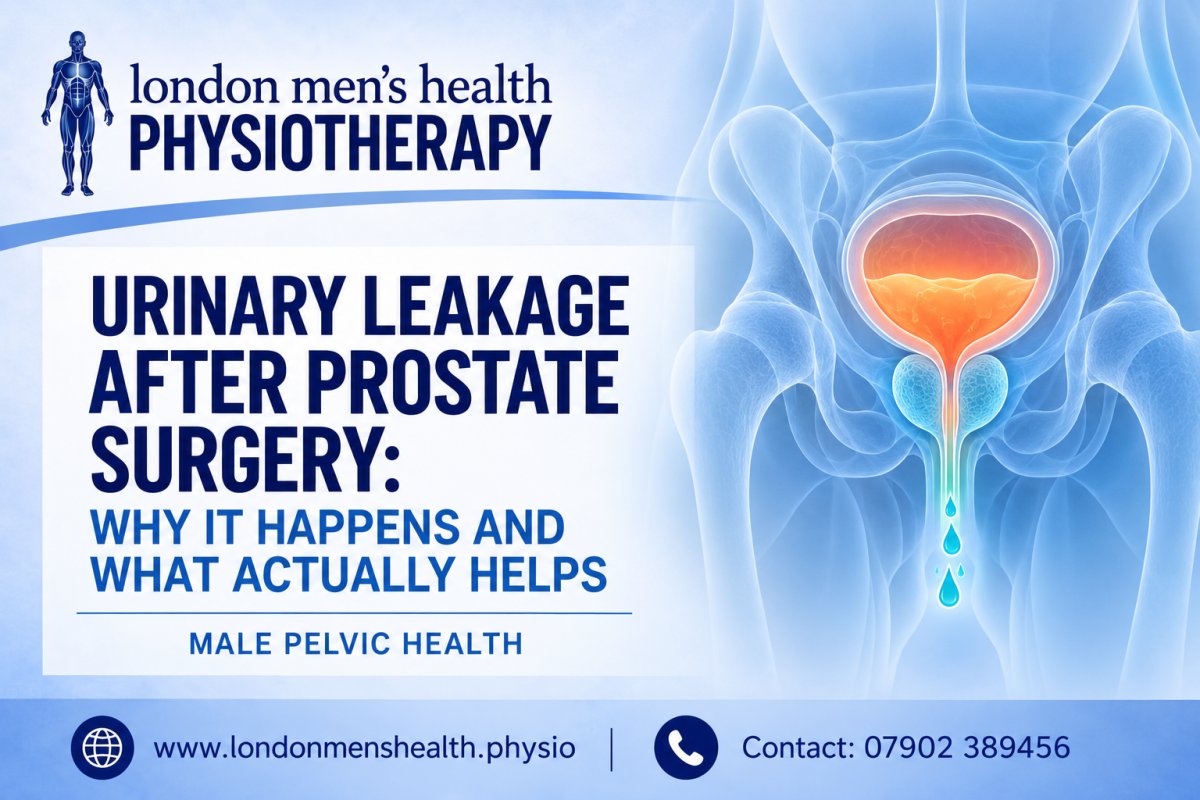
Urinary Leakage After Prostate Surgery: Why It Happens and What Actually Helps
A specialist Men’s Health Physiotherapy guide to getting your bladder control back after prostatectomy
Urinary leakage after prostate cancer surgery is one of the biggest concerns men have when they come to see us at London Men’s Health Physiotherapy.
For some men, bladder control starts improving quite quickly after the catheter is removed.
For others, leaking can continue for weeks or months and can have a major impact on exercise, work, travel, socialising and confidence.
The important thing to understand is that you do not simply have to “wait and see”.
There is a lot that can be done to help you understand your bladder control, retrain the pelvic floor and gradually return to normal activity.
Why Does Urinary Leakage Happen After Prostate Surgery?
During a radical prostatectomy, the prostate gland is removed and the anatomy around the bladder and urethra changes.
Before surgery, several structures contribute to urinary control. Following prostate removal, greater demands are placed on the remaining continence mechanism and the pelvic floor muscles.
This is why men commonly notice leakage when they:
• Stand up from a chair
• Walk quickly
• Cough or sneeze
• Bend or lift
• Exercise
• Get tired later in the day
• Have a fuller bladder
• Drink alcohol
• Move suddenly
This is usually referred to as stress urinary incontinence after prostatectomy.
The amount of leakage varies enormously between men.
Some may use only a small pad, while others may initially require several pads per day.
Is Leakage Normal After Radical Prostatectomy?
Some urinary leakage following prostate surgery is very common.
What matters is how your continence progresses over time.
In the early stages, men can sometimes become very focused on how many pads they are using each day. Pad use is useful information, but it is only one part of the picture.
We are also interested in:
• When you leak
• Which movements cause leakage
• Whether you are dry at night
• How well you can control your pelvic floor
• Your bladder frequency
• Your fluid intake
• Your ability to delay urination
• Whether leakage becomes worse as the day progresses
• Your exercise and activity levels
This gives us a much better understanding of what needs to change.
Pelvic Floor Exercises After Prostate Surgery
Most men are told to perform pelvic floor exercises.
That is good advice.
However, simply being handed a sheet of exercises and being told to “do your Kegels” is not always enough.
One of the most common things we find is that men are not completely sure whether they are contracting the correct muscles.
Others are performing hundreds of contractions each day but are not using the pelvic floor effectively when they actually need it.
Pelvic floor rehabilitation should be about much more than simply squeezing harder.
It Is About Timing, Coordination and Function
Your pelvic floor needs to work automatically during everyday movement.
For example, if you leak every time you stand up, we need to look at how you coordinate your pelvic floor with that movement.
If you leak when coughing, lifting or exercising, we need to practise using the pelvic floor during those activities.
Your rehabilitation might therefore progress from simple pelvic floor contractions to:
• Sit-to-stand movements
• Squats
• Lifting
• Walking
• Stairs
• Gym exercises
• Running
• Coughing and sneezing strategies
The ultimate goal is not to become brilliant at doing pelvic floor exercises while lying on a treatment couch.
It is to become continent during your normal life.
Can Ultrasound Help?
Yes.
One of the techniques we use in our London clinic is real-time ultrasound imaging.
Ultrasound can allow us to assess how the pelvic floor and surrounding structures are behaving without relying entirely on guesswork.
For many men, actually seeing the muscles working on a screen makes pelvic floor training much easier to understand.
It can help answer questions such as:
“Am I actually doing this correctly?”
“Am I holding my breath?”
“Am I pushing down instead of lifting?”
“Am I contracting too hard?”
“Can I relax properly afterwards?”
That visual feedback can be extremely useful when learning pelvic floor control.
More Exercise Is Not Always Better
A common mistake is assuming that if 30 pelvic floor contractions are good, 300 must be better.
That is not necessarily the case.
The pelvic floor is a muscle system like any other.
It needs an appropriate combination of strength, endurance, coordination and relaxation.
If your programme is too aggressive, you may simply fatigue the muscles.
Your programme should therefore be individualised and progressed according to your recovery.
What About Bladder Training?
Not every urinary symptom after prostate surgery is purely a strength problem.
Some men also develop:
• Urinary urgency
• Increased frequency
• Difficulty delaying the urge
• Frequent “just in case” trips to the toilet
• Anxiety about being too far from a toilet
These patterns can gradually reduce the bladder's tolerance for filling.
Part of rehabilitation may therefore involve bladder retraining, reviewing fluid intake and helping you gradually regain confidence in allowing your bladder to fill normally.
Can I Go Back to the Gym?
In most cases, returning to physical activity is an important part of recovery, but it needs to be appropriate for your stage following surgery and your surgeon's advice.
Men often worry that exercise will make their continence worse.
Initially you may notice more leakage during walking, lifting or exercise.
That does not necessarily mean you should avoid activity indefinitely.
Instead, we gradually integrate pelvic floor control into increasingly demanding movements.
The aim is to help you get back to the things that matter to you — whether that is walking, golf, cycling, running, gardening, the gym or sport.
What About Erectile Function?
Urinary continence is only one aspect of rehabilitation following prostate cancer surgery.
Radical prostatectomy can also affect erectile function and sexual function.
For this reason, our assessment can also include discussion around:
• Erectile function
• Penile rehabilitation
• Vacuum erection devices
• Medication prescribed by your medical team
• Returning to sexual activity
• Changes in orgasm and ejaculation
• Confidence and intimacy
Men's Health Physiotherapy should look at the whole person rather than concentrating only on whether you are wearing a pad.
When Should I See a Men's Health Physiotherapist?
You do not need to wait until you have been leaking for months.
Some men see us before prostate surgery so that they can learn how to correctly activate and relax their pelvic floor before the operation.
Others come once their catheter has been removed and their surgical team has advised that pelvic floor rehabilitation can begin.
And some men come to us several months — or even longer — after surgery because their continence has plateaued.
It is never simply a case of telling everyone to perform the same exercises.
A specialist assessment allows us to work out what you need.
What If I Am Still Leaking Months After Surgery?
Do not assume that because several months have passed nothing more can be done.
It is worth reviewing:
• Your pelvic floor technique
• Muscle endurance
• Functional coordination
• Bladder habits
• Fluid intake
• Exercise and loading
• The pattern and severity of your leakage
Persistent or significant incontinence should also be discussed with your urology team, as there are further medical and surgical options for some men when conservative treatment is not sufficient.
Physiotherapy is an important part of the pathway, but it should sit alongside appropriate specialist medical care.
Gerard's Clinical Insight
One of the most useful things I can say to men after prostate surgery is:
Don't judge your recovery from one bad day.
Continence recovery is rarely a perfectly straight line.
You may have a great morning and then leak more in the afternoon. You might notice more leakage after a long walk, after several busy days or when you are tired.
That does not automatically mean you are going backwards.
We look for the overall trend.
The aim of rehabilitation is to help you understand what your body is doing, progressively challenge the continence system and give you the confidence to return to normal life.
How We Can Help
At London Men's Health Physiotherapy, we regularly assess and treat men following prostate cancer surgery.
Rehabilitation can include:
• Specialist pelvic floor assessment
• Individualised pelvic floor muscle rehabilitation
• Real-time ultrasound imaging and feedback
• Bladder retraining
• Functional exercise rehabilitation
• Advice on returning to the gym, running and sport
• Support with post-prostatectomy erectile dysfunction and penile rehabilitation
• Vacuum erection device guidance where appropriate
Our aim is not simply to give you a list of pelvic floor exercises.
It is to help you get back to living normally.
London Men's Health Physiotherapy
Maria Elliott Physiotherapy Services
16 Glentworth Street, off Baker Street
London
NW1 5PG
Telephone: 07902 389456
Appointments are available with our specialist Men's Health Physiotherapy team in Central London.
Author:
Gerard Greene
Specialist Men's Pelvic Health Physiotherapist
London Men's Health Physiotherapy
PLEASE USE OUR ONLINE APPOINTMENT SCHEDULER
We are booking appointments through October, 2026.
If you would like to schedule an appointment beyond October, 2026 or have any other appointment needs or questions please contact London Men's Health Physio using the form below or by phone, 07902 389456.
