
POST-PROSTATECTOMY MOT
Stop guessing. Start recovering.
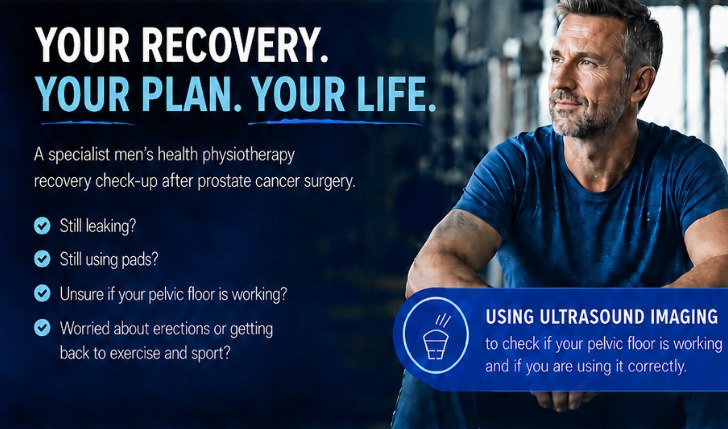
Surgery for prostate cancer is only the start. The weeks and months after it are when most men are left to get on with it, with a leaflet and a pelvic floor exercise and a lot of questions. Our MOT is a single appointment with Gerard in our London clinic that goes through the lot and ends with a plan.
Book your MOT Ask a question in confidence

The questions we hear every week
- Am I doing my pelvic floor exercises correctly?
- Why am I still leaking?
- When can I stop wearing pads?
- Is my bladder pattern normal?
- What can I do about erections, and does a vacuum pump help?
- Why do I leak during sex?
- When can I get back to the gym, the golf course, work and normal life?
The MOT is designed to answer those. It uses ultrasound where appropriate, hands-on assessment and straightforward advice, and it is led by a men's health physiotherapist who does this every day.
The seven parts of your MOT
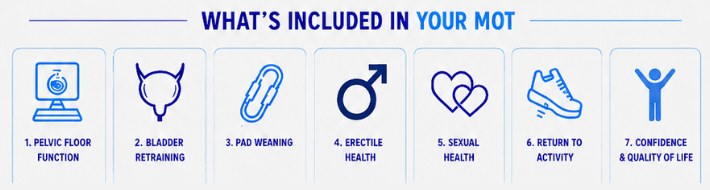
- Pelvic floor check: See whether the muscle is lifting properly, or whether bracing, pushing down or breath-holding is getting in the way.
- Bladder retraining: Sort out the “just in case” trips and the urgency, and rebuild a calmer pattern.
- Pad weaning: A step-by-step plan to use fewer pads as control improves, at a pace that suits you.
- Erectile health: Practical rehabilitation advice, including how to use a Somaerect vacuum pump safely.
- Sexual health: Straightforward help with leaking during arousal or orgasm (climacturia).
- Return to activity: A route back to work, the gym, golf, running, cycling and sport.
- Confidence: Clear answers and a written-down plan, so you are not left guessing.
Why lying-down exercises are not enough
Most men are told to squeeze their pelvic floor and few are ever checked. Some brace too hard. Some hold their breath, or clench their buttocks, stomach or thighs instead. Some cannot let go afterwards.
And even a perfect squeeze on a treatment bed does not guarantee control at the bus stop. Leaks happen when you get up from a chair, cough, bend, lift, take the stairs, play golf or get tired at the end of the day. So we test and train the pelvic floor in those situations, not only lying down.
Your programme might include:
- Standing pelvic floor work
- Timing the squeeze to a movement
- The Knack before a cough, sneeze or lift
- Sit-to-stand control
- Walking strategies
- Gym, golf, running and cycling progressions
Seeing it on the screen
Ultrasound lets us watch your pelvic floor as you use it, and lets you watch too. In practice that means we can say, with evidence, whether you are lifting or pushing down, whether you are working too hard, whether you can relax afterwards, and whether the technique changes when you stand up or move.
It also tells us whether the programme you are on suits where you are in your recovery. Most men find this the most useful ten minutes of the appointment.
Your bladder
It is easy to fall into habits after surgery: going to the toilet just in case, drinking less for fear of leaks, rushing when you feel the urge, or avoiding places without a toilet nearby. We go through how often you go, what and how much you drink, urgency, getting up at night and how it all affects work, travel and exercise. Then we work on getting your bladder back into a calmer routine.
Coming off the pads
Some men stay in pads for longer than they need because they are anxious. Others cut down too quickly, have a bad day and lose heart. We look at how many you use, when you leak, how much, what sets it off, and whether the pad is there for security or for need. Then we agree a realistic plan.
There is no race. The aim is fewer pads, less worry and more freedom.
Erections and the Somaerect pump
Erectile problems are common after prostate surgery, and they touch confidence, relationships and how a man sees himself. Many men feel nobody has given them proper practical advice.
In your MOT we can talk through:
- How vacuum pumps are used after surgery, and how regular blood flow may help rehabilitation
- How to use the Somaerect safely, and how often
- How to build a routine you can keep up, and the common mistakes to avoid
- How it fits with medication, and when to go back to your urologist or GP
Leaking during sex
Leaking at arousal or climax (climacturia) is a known side effect, and a very awkward thing to bring up with anyone. Here it is just another topic. We can cover emptying your bladder beforehand, timing your pelvic floor, practical tips and talking to your partner, and we will say if it is worth seeking more medical advice.
Everything is discussed plainly and respectfully. Many men tell us the biggest relief was finding out they are not the only one.
Getting back to your life
Getting dry is not the end goal. The goal is to do what you did before, without a second thought. We plan your return around your operation, symptoms, fitness and goals, covering:
- Walking, work, travel and lifting
- Gym, running and cycling
- Golf, racket sports and team sports
- Sex, and everyday confidence
Is this you?
You have had prostate cancer surgery and you are:
- Still leaking
- Still using pads
- Not sure your pelvic floor exercises are right
- Want ultrasound to check your technique
- Urgency, or bladder habits you would like to change
- Want help to reduce pad use
- Struggling with erections
- Using, or thinking about, a Somaerect pump
- Leaking during arousal or orgasm
- Want to get back to the gym or sport
- Feel your recovery has stalled
- Want straight answers and a plan
It makes no difference whether your operation was last month or years ago.
What you will leave with
By the end you should know:
- Whether your pelvic floor is working properly
- Whether your exercise technique needs to change
- How to use your pelvic floor when you are on your feet and moving
- How to improve your bladder pattern
- How to approach cutting down on pads
- How to support erectile rehabilitation, and use a Somaerect pump safely
- How to manage leaking during sex
- How to get back to exercise and sport
- What your next steps are
Straight answers
Is this just a pelvic floor lesson?
No. The pelvic floor is one part. We also look at your bladder habits, pad use, erections, leaking during sex, and what you want to get back to doing.
Can you tell me if I am doing my exercises properly?
That is one of the main reasons men come. Ultrasound, where appropriate, lets us see whether the muscle lifts, and whether you are bracing, pushing down or holding your breath instead.
How do I get off the pads?
We work out how much you leak, when, and why, then agree a sensible way to cut down. Not too fast, and not so slow that you stay in pads out of habit.
Can you help with erections?
Yes. We can go through rehabilitation, including how to use a Somaerect vacuum pump safely, and tell you when it is worth going back to your GP or urologist.
I leak when I climax. Is that something I can raise?
Yes. It is called climacturia, it is a recognised result of this surgery, and we talk about it every week. There are practical things that help.
My surgery was a long time ago. Is it too late?
No. Men come soon after surgery and years later. If you are still leaking or your recovery has stopped improving, it is worth a check.
I play sport. Will you cover that?
Yes. Gym work, golf, running, cycling, racket and team sports can all be built into your plan.
Can I do it online?
The MOT is available in London, in Birmingham and online. Get in touch and we will tell you what works best for you.
Book your MOT
Our London clinic is at 16 Glentworth Street, off Baker Street, NW1 5PG. The MOT is also available in Birmingham and online. Pick a time below, or use the form to ask first.
Ask a question in confidence
Not sure it is right for you? Send us a message or call 07902 389456.